

We make a soft baseball, so you'd expect us to tell you it beats a wiffle ball at everything. It doesn't. They're built for different things, and if you pick wrong you'll be annoyed.
Here's the honest version.
What a wiffle ball is good at
It moves. That's the whole design. The holes on one side make it curve, and a decent pitcher can make it do things no other ball does. If the fun you're after is trying to hit a pitch that breaks two feet, nothing else comes close.
It's cheap. A couple dollars. If it ends up on a roof, you shrug.
It's light. It won't break a window even if you catch one clean. For a small yard with houses close by, that matters.
It's the right call if: you're playing wiffle ball. Pitching, swinging for the fence, no fielding, small space.
Where a wiffle ball falls short
It doesn't feel like a baseball. It's light and hollow, and hitting one doesn't teach you much about hitting a real one. Timing is different, weight is different, contact is different.
You can't really field it. It won't stay in a glove and it doesn't come off a bat like a baseball. Ground balls skitter. Fly balls float. If you're trying to practice actual fielding, it's the wrong tool.
They crack. Especially in cold weather or with an older kid swinging hard. A split wiffle ball is done.
You can't throw a normal ball with it. No seams to grip, so a kid learning to throw is learning on something that behaves nothing like what they'll use in a game.
Where the Kore Ball is different
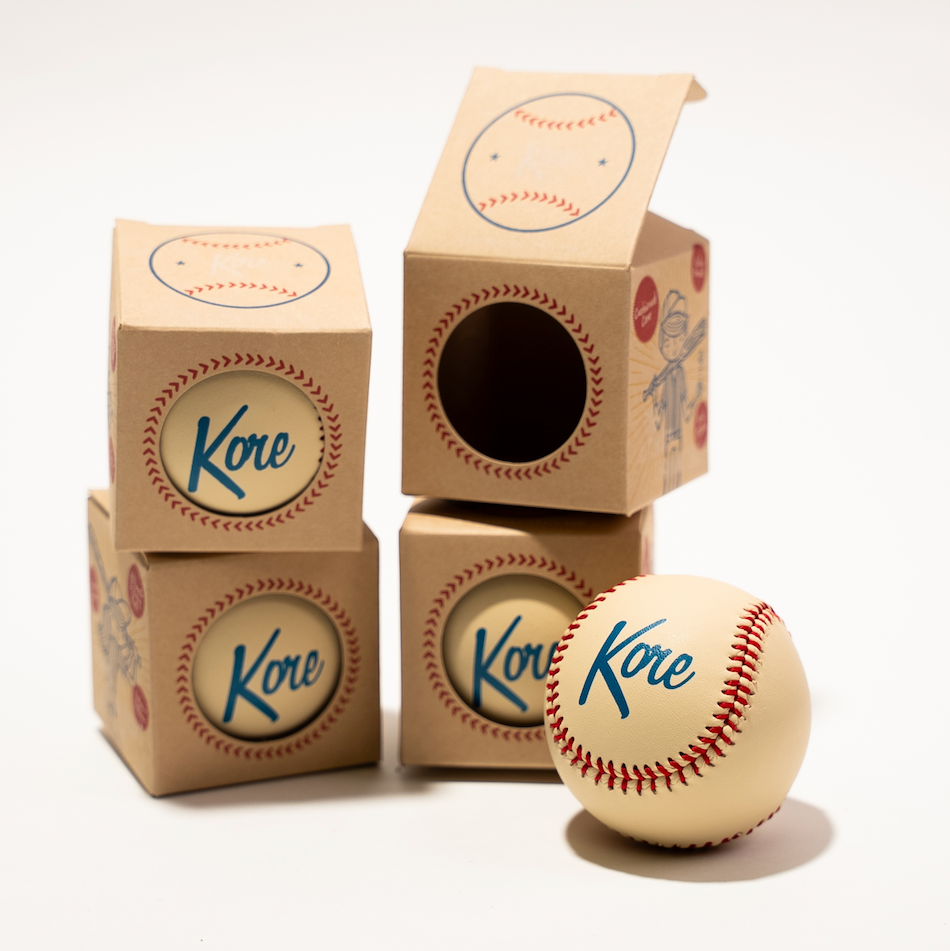
We built ours around a cushioned foam core with a hand-stitched cover. It's the same size as a regulation baseball and weighs about 2 oz.
It feels real. The stitched cover gives a kid something to grip, so they can learn to throw properly. Same size, so a glove works normally.
You can field with it. It comes off the bat like a baseball and sits in a glove. Ground balls, fly balls, soft toss — it behaves the way a baseball does, just softer on impact.
It doesn't crack. No plastic shell to split. It holds up through a season of real use.
It works indoors. Living room, basement, hallway. That's more useful in February than you'd think.
Where it's the right call: teaching a kid to play, practicing with a glove, backyard games where people want to field, and anywhere you want the game to feel like the game.
Where the Kore Ball loses
It won't curve. No holes, no movement. If your kid's whole thing is throwing a wiffle ball that breaks a foot and a half, we don't do that.
It costs more. $8.99 versus a couple dollars. It lasts a lot longer, but the upfront number is higher.
It's heavier. Two ounces isn't much, but it's more than a wiffle ball. In a very tight space with a lot of glass, a wiffle ball is the safer pick.
The short version
| Wiffle ball | Kore Ball | |
|---|---|---|
| Curves and moves | Yes | No |
| Feels like a real baseball | No | Yes |
| Works with a glove | Not really | Yes |
| Can you field it | No | Yes |
| Holds up over time | Cracks | Doesn't |
| Indoor safe | Yes | Yes |
| Cost | ~$2 | $8.99 |
Get a wiffle ball if you want to pitch and hit in a small space and you like the movement.
Get a Kore Ball if you want backyard baseball that feels like baseball — throwing, catching, fielding, and hitting that carries over to a real game.
Plenty of families have both. They're not really competing.
If you want to try one, here's the Kore Baseball. There's also a 4-pack if you've got a group, and a 12-inch softball if that's your game.